Forecast for the Salt Lake Area Mountains

Brooke Maushund
Issued by Brooke Maushund on
Saturday morning, March 14, 2026

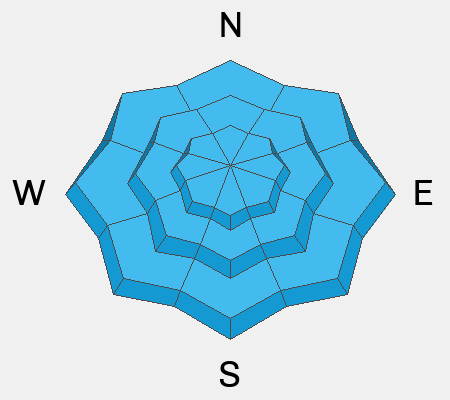
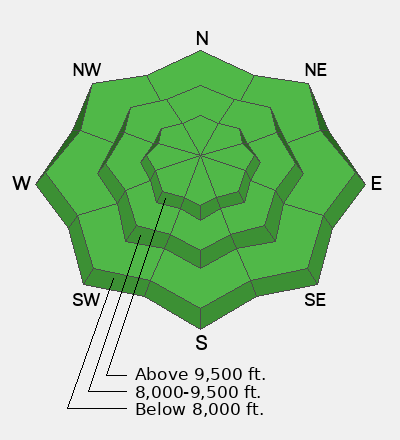
The avalanche danger is LOW. Travel in the mountains is inherently risky, so Normal Caution is advised. You are unlikely to trigger an avalanche.

The buried PWL (persistent weak layers) are mostly dormant and triggering one of these is unlikely but not impossible. Continue to avoid glide avalanche terrain such as Stairs, Broads, Mill B South, and upper Porter Fork.
Low
Moderate
Considerable
High
Extreme
Learn how to read the forecast here
Special Announcements

Spring Campaign and Spring Auction - Each spring, we ask for your continued financial support to fund our forecasting and education programs. We hope you will consider supporting our mission by checking out our campaign and auction, live and available HERE.

Weather and Snow

Yesterday, mountain highs reached close to 50°F near the heat of the day under mostly sunny skies. Light to moderate winds blew from the W. Overnight, we saw the second night of a weak refreeze, with lows just around freezing in most locations. While the increasing W winds helped surfaces cool off, the mid-pack did not get enough time to fully refreeze.

Today skies are mostly cloudy as winds continue to blow in the 20s-30s mph out of the W. Temps will reach the high 30s during the day. A cold front blows in late this afternoon, bringing with it increasing NW winds throughout the day and a stark drop in temperatures to single digits late tonight.

Tonight, frontal passage is set for near or after sunset, and could bring winds >100 mph before tomorrow morning. The front will bring showers dropping 0.3" of H2O overnight, but there's a decent amount of uncertainty around accumulation. Water's likely to fall as graupel with convective activity in the atmosphere. Maybe 2-4" graupel/snow if we're lucky before next week's absurd warm-up (some might call it a meltdown).

The Week in Review is Hot off the Press - Click HERE

Recent Avalanches

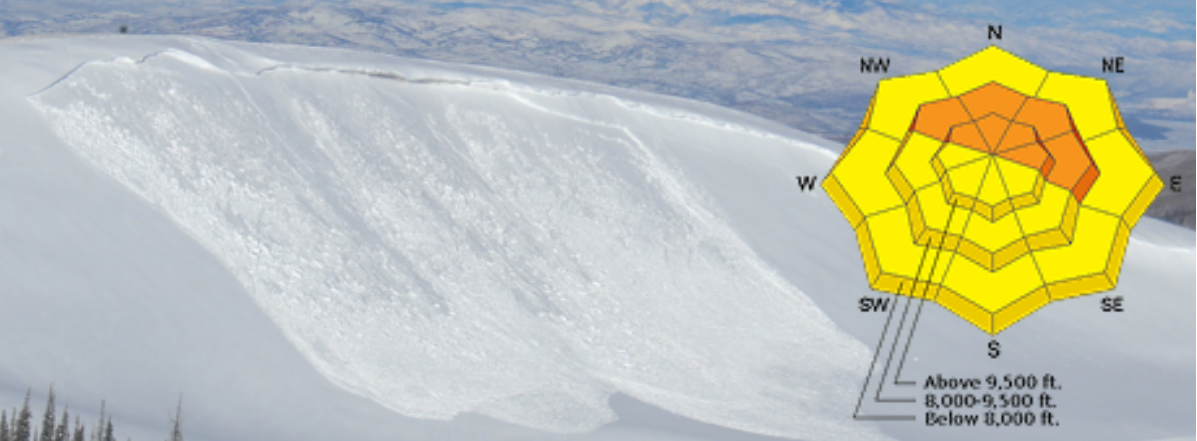
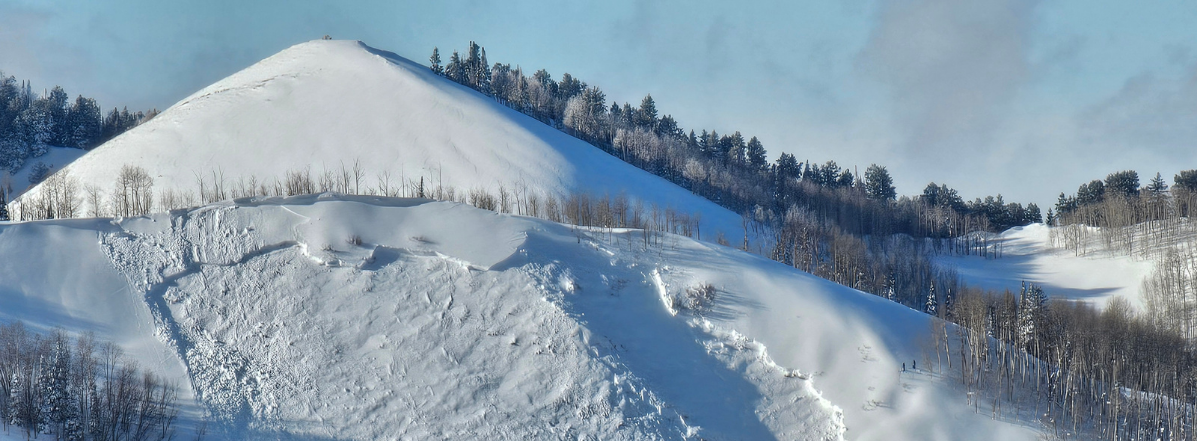
Glide avalanche Blue Ice (NE, 10300') yesterday: Grainger, Young, & Anderson watched a 5' deep, 100' wide glide avalanche release on Blue Ice yesterday afternoon.

You can find more observations from the Salt Lake zone HERE.

Avalanche Problem #1
Normal Caution
Type
Location
Likelihood
Size
Description

It is always best to follow safe travel practices regardless of the avalanche danger: cross slopes one at a time, be aware of who is above and below you, and keep an eye on your partner.

Glide avalanches have been releasing naturally in the past week, like in Broads yesterday. These full-depth and destructive slides are difficult to forecast and it's worth avoiding known habitat (on steep and smooth quartzite slabs) and their runouts in areas such as Stairs, Broads, and Mill B South of Big Cottonwood Canyon, and upper Porter Fork in Mill Creek.

Wet snow: The winds during the day today should keep surface-level wet loose activity mostly at bay, but know the mid-pack hasn't seen a full refreeze in 2 days. Wet slabs can't be ruled out as an unlikely possibility.

Cornices tend to calve naturally during the springtime. Avoid being on or beneath these ridgeline hazards.

Wind-drifted snow: Be aware of small, pockety old hard wind slabs in isolated, rocky high alpine terrain.

Persistent weak layer (PWL) was dropped as a problem today, but keep it on the forefront of your mind in steep, unsupported, extreme northerly terrain. More on that below.

Additional Information

What does it mean to drop the PWL?


Graphic courtesy of Joe Stock's 2024 piece in The Avalanche Review.

You'll notice that we dropped the persistent weak layer (PWL)—that's responsible for 4 deaths since mid-February—as a problem today. What we want you to know is that there is a fair bit of uncertainty around dropping a PWL from the forecast. We don't drop a PWL because it's impossible to trigger. In fact, it is literally impossible to be 100% certain that there is not a single lingering weakness. As seen in the graphic, a PWL comes with an inherently higher amount of uncertainty, as do glide avalanches—like the one that ran in Broads yesterday. Know as you travel today that uncertainty lingers in the mountains—and we deal with uncertainty by adding margins. Visiting avalanche pro Lisa Van Sciver put it well in her ob when she wrote, "While the snowpack in this is area is generally stable, in extreme terrain especially unsupportable slopes this structure should be considered..."

Uncertainty is a tough thing to communicate in avalanche forecasting; that's why multiple PhDs are studying it. An important finding so far is that explicitly stating our uncertainty in our forecasts increases trust in the avalanche center. So know: we have some surrounding the PWL. As temps skyrocket next week, know you may find it coming back into the forecast.

General Announcements

This information does not apply to developed ski areas or highways where avalanche control is normally done. This forecast is from the U.S.D.A. Forest Service, which is solely responsible for its content. This forecast describes general avalanche conditions and local variations always occur.