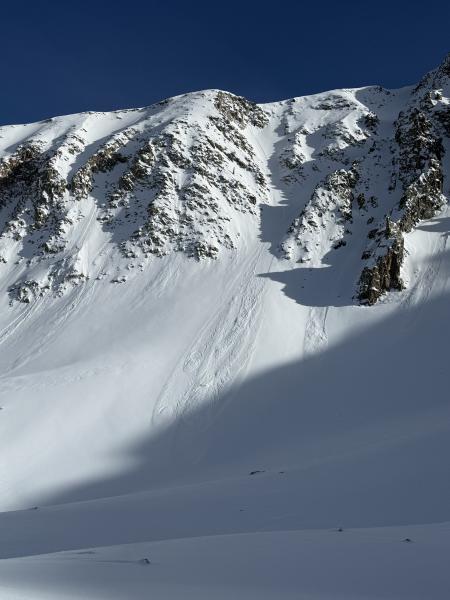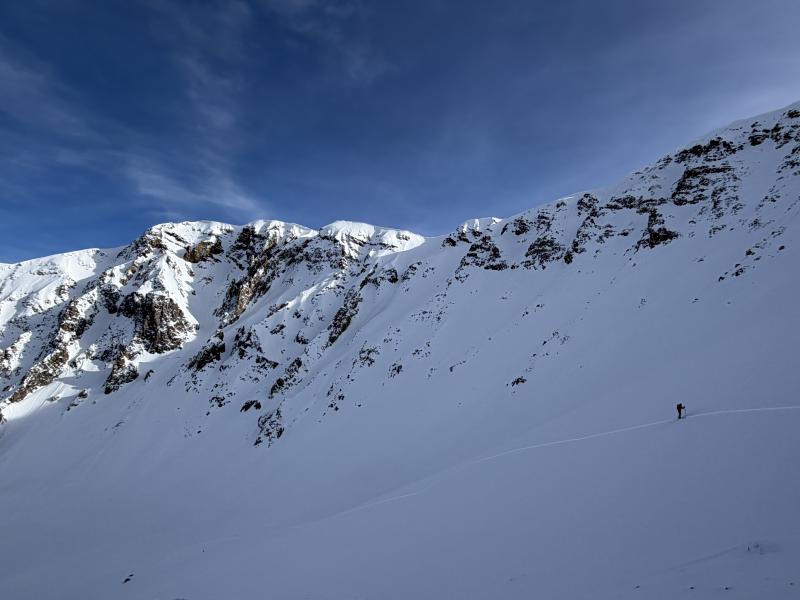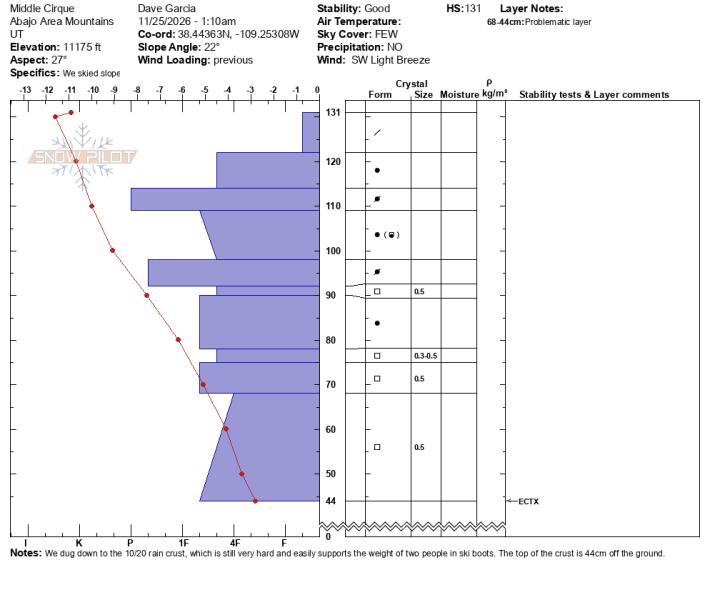
Our goal for the day was to get above treeline and into the wind zone to assess snowpack stability on northerly aspects. We dug this profile on an open, exposed NE-facing slope at 11,175'. Previous wind loading is evident in the upper snowpack. The layer of facets above the rain crust is surprisingly dense, with hardness ranging from 4F to 1F- and a maximum grain size of 0.5 mm.
We performed an Extended Column Test with no results (ECTX). Following the test, I pulled on the column with my shovel, and the entire column came out as one cohesive block, despite the distinct layering visible in the profile. This result, combined with several days without reports of cracking or collapsing, gave us enough confidence to cautiously step out into bigger terrain. However, we continued to manage our exposure by keeping slope angles below 35° and avoiding steep convexities, shallow rocky areas, and thin slab margins.
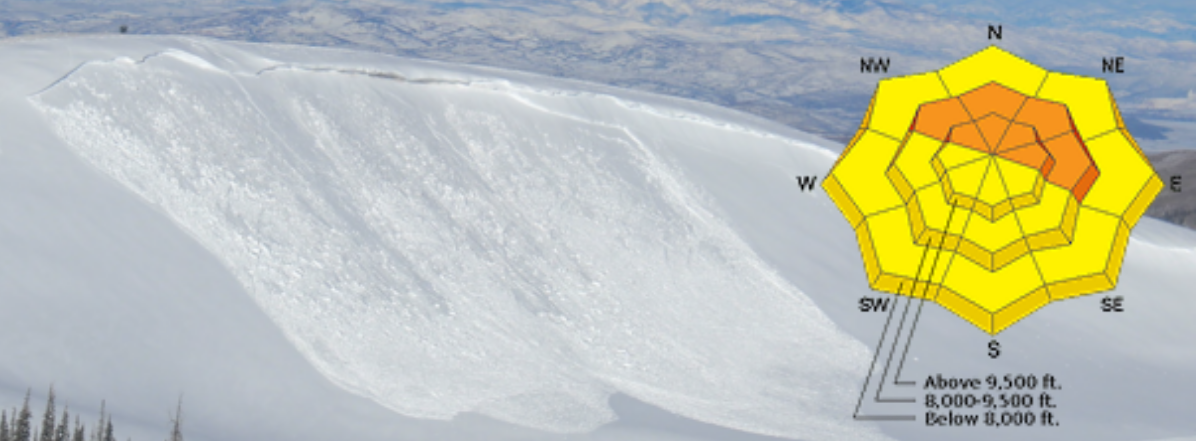
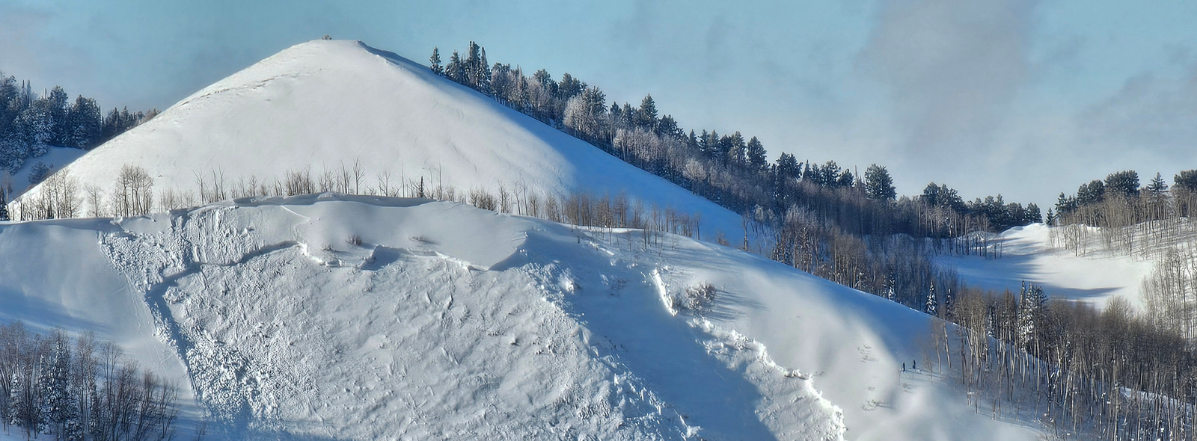
Make no mistake, poor snowpack structure remains. While the likelihood of triggering an avalanche is decreasing, human-triggered avalanches remain possible.
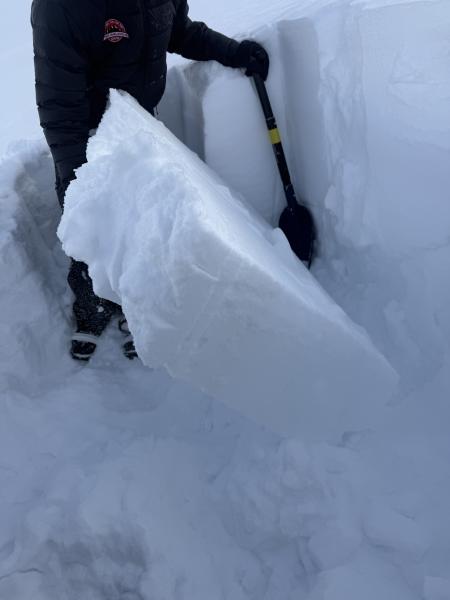
Cohesive block of snow after the extended column test.