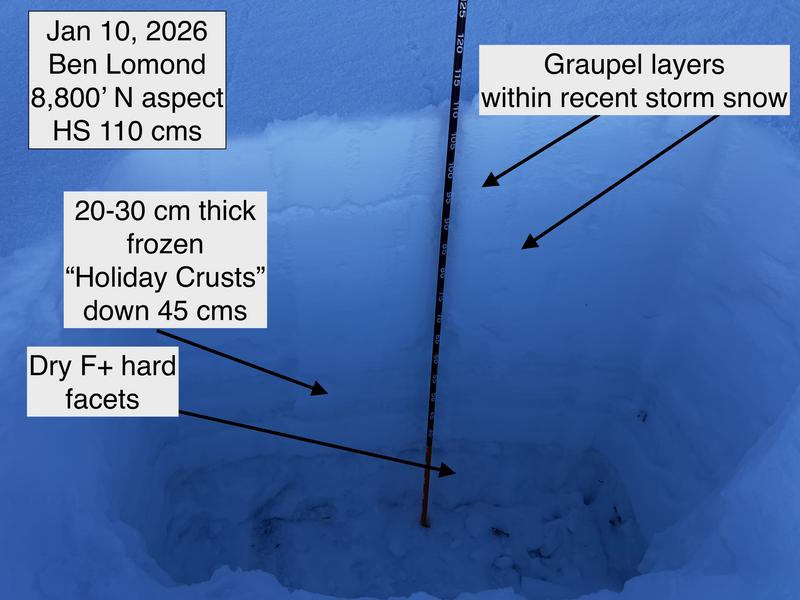
I traveled up Cutler Ridge on Tuesday, January 6 and spent time looking at the snowpack up to 8,500 feet where the facets at the ground were either non-existent or damp and gaining strength. Today, I wanted to focus on higher elevations and made it to 8,800 feet where I found dry facets below crusts from the rain events around the holidays. However, the crusts above the facets were strong - generally 20-30 cms thick - and were difficult to dig or saw through.
I then probed around quite a bit around Bailey Springs searching for spatial variability of the crusts, but everywhere I looked, the crusts were similarly thick, or in some areas, I found a 5-10 mm ice lens from rain events.
The presence of facets in a snowpack is always a concern, and I imagine there may be some outlying areas at the uppermost elevations where the crust is thinner and there are facets below, but given there has been no indication of natural avalanche activity along the Ogden Skyline, and the snowpack I looked at in these two field days, I feel confident the facets at uppermost elevations are gaining strength and are shielded by the very strong holiday crusts above.
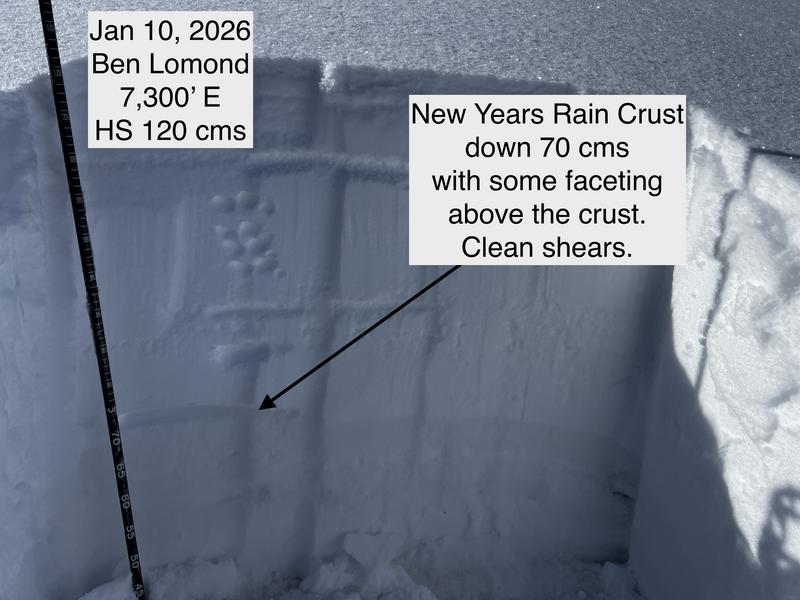
I've noticed there are some facets down 45-75 cms right above the New Years Rain Crust (NYRC) where I'm continuing to get clean shears in the layer of facets right above the crust. Stability tests were all poor quality ECTN. A temperature profile showed a temperature gradient right around the crust, so faceting is likely to continue. This will be the weak layer I'll be watching going forward.
Photos:
- Strong rain crust with dry facets underneath at upper elevations
- NYRC with some faceting just above the crust.
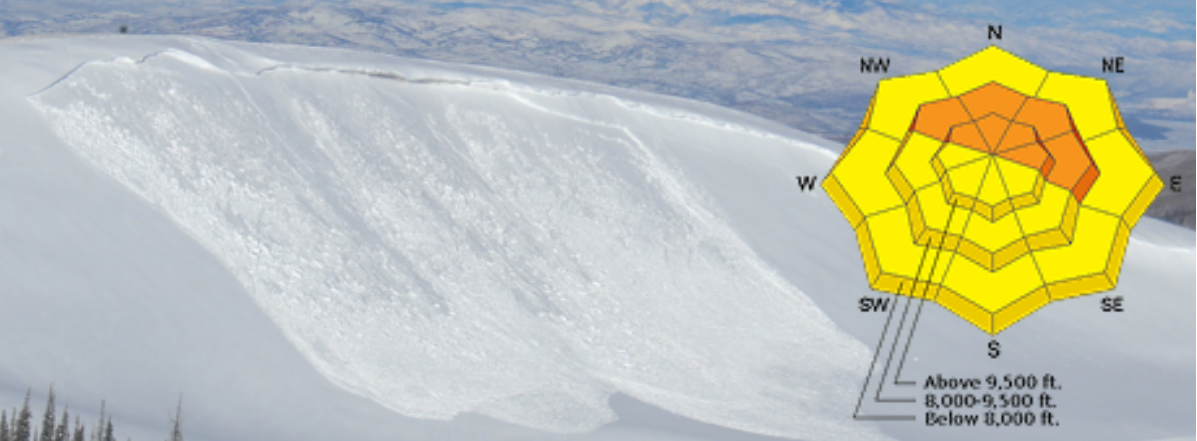
I would call the danger Low where I was traveling today.