Forecast for the Salt Lake Area Mountains

Nikki Champion
Issued by Nikki Champion on
Wednesday morning, March 18, 2026

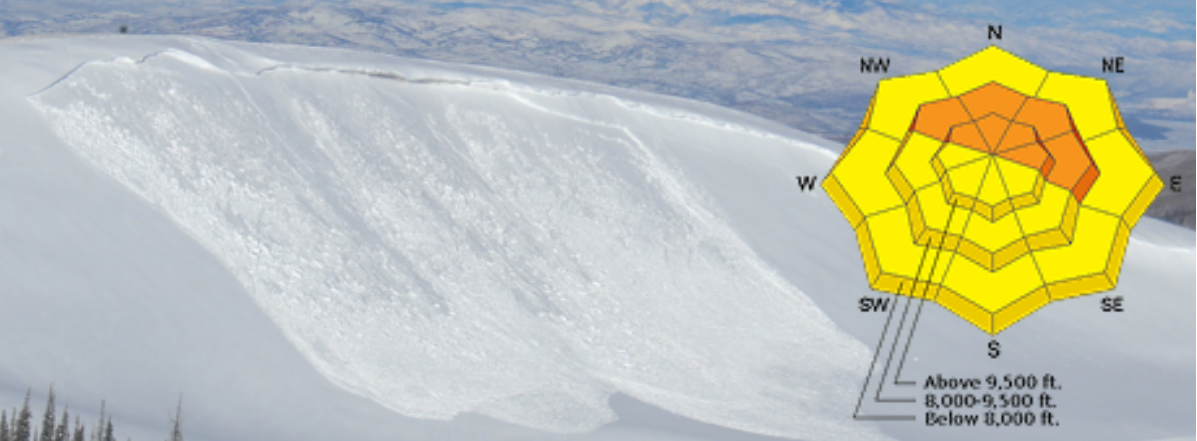
Throughout the day, avalanche danger will rise to MODERATE as temperatures climb and skies remain clear. Small wet loose avalanches and larger wet slab avalanches will become possible on any sunny, wind-sheltered slopes.

Pay attention to changing conditions; if a slope becomes unsupportable, it’s time to switch aspects.

Elevated winds may keep most of the wet snow in check at upper elevations today, but avalanche danger will keep rising across all slopes and elevations as the warm-up continues over the next few days.

Continue to avoid glide avalanche terrain such as Stairs Gulch, Broads Fork, Mill B South, and the Porter Slabs in upper Porter Fork.

Low
Moderate
Considerable
High
Extreme
Learn how to read the forecast here
Special Announcements

Spring Campaign and Spring Auction - Each spring, we ask for your continued financial support to fund our forecasting and education programs. We hope you will consider supporting our mission by checking out our campaign and auction, live and available HERE.

Weather and Snow

This morning, skies are clear, and temperatures are in the upper 30s °F at ridgetops and in the upper 40s to low 50s °F at trailheads and mid-mountain. No weather station in the region consistently dropped below freezing overnight, though long-wave radiation may have lent itself to a superficial freeze this morning. Winds are from the west to northwest and have finally begun to decrease, with gusts between 20 - 30 mph along exposed mid- and upper-elevation ridges and peaks. As is often the case, 11,000-foot winds are much stronger, with averages near 50 mph.

Today, skies will remain clear and mostly sunny. High temperatures are expected to increase by another 10 degrees compared to yesterday, rising into the upper 50s and low 60s °F. Winds will diminish slightly throughout the day but remain elevated along ridgetops, with gusts into the 40s mph, which could keep the uppermost elevations cooler.

This week, a summer-like ridge over the area will bring high temperatures up to 30 °F above seasonal norms across Utah and southwest Wyoming for the latter half of the week. These historic highs, more typical of early June than March, are likely to break many temperature records. Graphic below courtesy of our partners at the National Weather Service.

Recent Avalanches

Ski resorts reported minimal wet-loose activity yesterday.

You can find more observations from the Salt Lake mountains HERE.

Avalanche Problem #1
Wet Snow
Type
Location
Likelihood
Size
Description

With temperatures surging across the range, more than 30 °F above normal, wet avalanche activity will increase in both likelihood and size over the coming days, with both wet loose avalanches and larger wet slabs becoming possible.

It’s time to start thinking about large wet slab avalanches. There is a lot of uncertainty about how wet slab avalanches will behave over the coming days; some slopes may barely move, while others could release much larger slabs. It’s hard to know exactly how things will unfold, and I have to admit that uncertainty keeps me paying close attention and building in a larger margin of caution.

We still have a well-structured snowpack with a mix of crusts and the lingering persistent weak layer we dropped going into the weekend. This layer could become active again as meltwater percolates down to the facets, potentially leading to larger, more connected, and more destructive avalanches. Pay attention to how supportable the snow surface is, how strong or shallow the overnight refreeze is, and how saturated the snowpack is becoming. These larger avalanches will likely move to the forefront as the week progresses.

For both of these problems, the travel advice remains the same for now. Rollerballs, pinwheels, and sinking deeper into the snow than you were earlier are signs it’s time to get out of there. Watch for terrain traps below, such as gullies or cliffs, where even a small avalanche can have serious consequences. Pay attention to changing conditions, and keep an eye on your aspect and timing.

Additional wet-snow problems:

  • Glide avalanches: These have been releasing naturally over the past week, including in Broads Fork on Friday. These full-depth, destructive slides are difficult to forecast. It’s worth avoiding known glide paths on steep, smooth quartzite slabs and their runout zones, especially in areas like Stairs, Broads Fork, and Mill B south of Big Cottonwood Canyon, as well as the Porter Slabs in upper Porter Fork in Mill Creek.
  • Cornices: These tend to calve naturally in the spring. Avoid traveling on or beneath ridgelines where cornices hang overhead.
General Announcements

This information does not apply to developed ski areas or highways where avalanche control is normally done. This forecast is from the U.S.D.A. Forest Service, which is solely responsible for its content. This forecast describes general avalanche conditions and local variations always occur.