Forecast for the Moab Area Mountains
Wednesday morning, December 3, 2025
Geyser Pass Road Conditions: The road has not been plowed and you will find 4-8 inches of new snow on top of the old icy and snow packed surface. 4 wheel drive is required.
It's Avalanche Awareness Week!
Tonight - Don't miss our free Know Before You Go avalanche awareness talk at the Moab Arts and Recreation Center, 111 E 100 N at 5:30 p.m.
Saturday, December 6 - 18th Annual Utah Snow and Avalanche Workshop (USAW). This session will be held in-person at the Wasatch Jr High School Auditorium. 3750 S 3100 E, Salt Lake City, UT 84109. Information and tickets are available here.
Saturday, December 13 - Winter Kick Off Party Bring your skis or board to wax, listen to live music, and bring in another winter season with our local community. Tickets available online now!
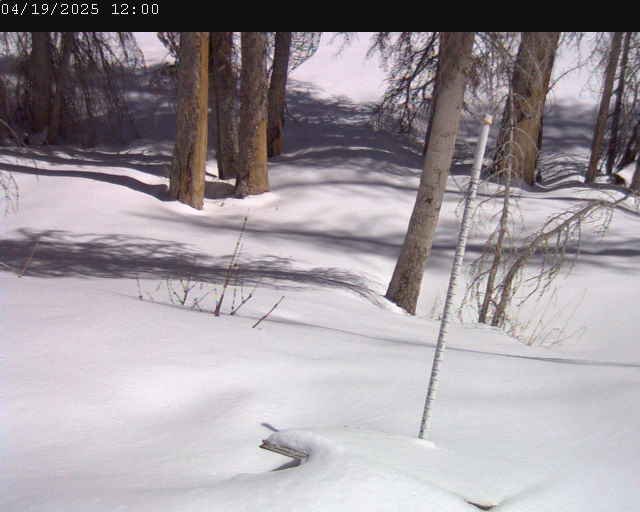
24 Hour Snow: 1" 72 Hour Snow: 10" Season Total Snow: 21" Depth at Gold Basin: 17"
Winds on Pre-Laurel Peak: 5 NW Temp: 18° F
Weather
A weak short wave on a northerly flow will continue to bring light snow showers to our region. Skies will be mostly cloudy, and snowfall is expected to taper off by this afternoon. Any additional accumulation will be light, with 1-2 inches possible. Winds will be light out of the northeast, and temperatures will hover around 20°F. Skies will clear tonight. The rest of the week will be sunny and calm with highs in the mid-20s°F. Beginning Friday, the flow becomes northwesterly, and the mountains of northern Utah and Colorado will see accumulating snow. A weak ridge over the Four Corners looks to leave us high and dry, but light snowfall may become possible this weekend.
General Conditions
Travel was somewhat difficult while cruising around the Laurel Highway and Gold Basin yesterday. I found deep trail breaking off the beaten path that made for slow going. The average height of snow above 10,000' is 18-24". The snowpack is weak and faceted, allowing skis to punch deep when traveling downhill and attempting to make turns. Rocks and logs are a real hazard right now, and the punchy snow doesn't help. The good news is that soft powder exists on all aspects, so if you can find a grassy slope, you might be able to make some turns.
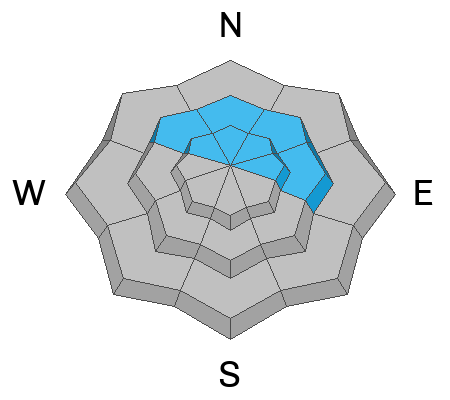
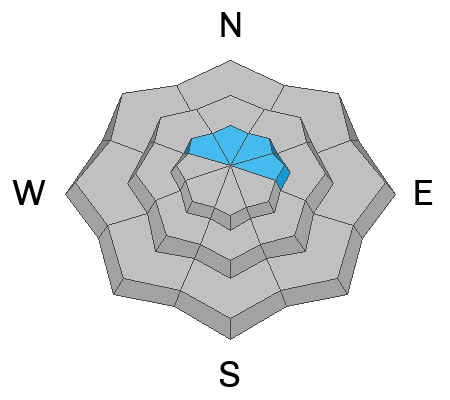
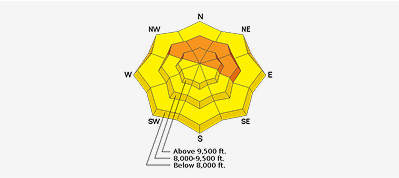
Old, pre-existing faceted snow was buried by 9 inches of storm snow on Sunday, laying an evenly distributed slab on top of a persistent weak layer. We observed numerous small avalanches on Monday, and test results continue to be sensitive. Avalanche danger is most prevalent on northerly aspects where the snowpack is deeper and more well-connected. The weak layer is especially sensitive, and above treeline slopes that have seen just a touch of wind-drifted snow are especially suspect.
Poor snowpack structure also exists on slopes that face west and southwest. Many slopes near or above treeline with a west or southwest aspect were subject to strong sun and/or strong winds and do not have much of a snowpack at all. The PWL problem does not exist on these slopes. However, if you find yourself on southwest or west-facing slopes, and the snowpack is deep, dig down and look for the weak layer; it is easy to find.
Click here to check out all recent obs, including my fieldwork from Tuesday.
Check out the video below from our fieldwork on Monday

Sunday's storm deposited a very soft slab that now sits on top of weak faceted layers of older snow. In many areas, this slab is still too soft to produce an avalanche, but where it has gained cohesion—especially in wind-loaded terrain—avalanches large enough to bury a person are possible. As the recent snow continues to settle, and the slab becomes denser, the weak layer will become more sensitive. For now, observers are reporting shallow slabs breaking on facets at the old snow surface in stability tests.
The photo below, from my fieldwork on Tuesday, illustrates the results of an extended column test (ECTP 9) with a soft slab failure on facets at the old snow surface.
It's never too early to start thinking about avalanches. Here are a few things to consider doing: